
Douglas County Bench Warrants Explained
A bench warrant is an arrest order that comes straight from the judge's own bench, as the Nebraska Judicial Branch defines it. In Douglas County one can follow a missed County Court Criminal/Traffic appearance. It can also follow a skipped District Court felony setting. Other triggers include ignoring a court order, falling out of step with probation, or a show-cause matter. Defaulting on fines or costs counts too. None of this creates a new criminal charge by itself. It enforces a duty inside a case that already exists. The issuing court decides the next step. The sheriff or police may serve it, and DCSO policy labels many unpaid-fine and show-cause orders as a capias mitimus.
Douglas County Bench Warrant Triggers
Whatever you missed points you to the right phone. Miss a traffic date, a misdemeanor setting, or a municipal-ordinance case in Douglas County? County Court Criminal/Traffic is the likely source. A felony setting runs through District Court. Probation and show-cause events may take instruction from the court or the probation office. Omaha Municipal Court matters go to that court itself, since city ordinance cases may not appear in a county-facing roster.
| Trigger | Likely court | First question |
|---|---|---|
| Missed traffic or misdemeanor date | Douglas County Court | What reset, payment, or hearing is available? |
| Missed felony setting | Douglas District Court | Is counsel required for a new setting? |
| Fine or cost default | Issuing court | Does section 29-2412 apply? |
| Omaha ordinance FTA | Omaha Municipal Court or named court | Which city clerk confirms the order? |
Douglas County readers can start with the official Nebraska bench-warrant explanation for the term itself, then bring the case to the local clerk.
How Douglas County Bench Warrants Are Issued
A judge signs a bench warrant only after the record shows a missed event or noncompliance worth enforcing. The docket may list the missed hearing, an FTA, a show-cause order, a fine, or a new setting. Nebraska JUSTICE can surface those entries by party name or case number. It does not show the sheriff's full status. A brand-new order may not even appear there yet. Court and agency records can carry different timestamps too. So ask the clerk whether the order was entered, recalled, quashed, or served. Then confirm status with DCSO or Douglas County 911. That two-part check beats trusting a single docket word as the final answer in Douglas County.
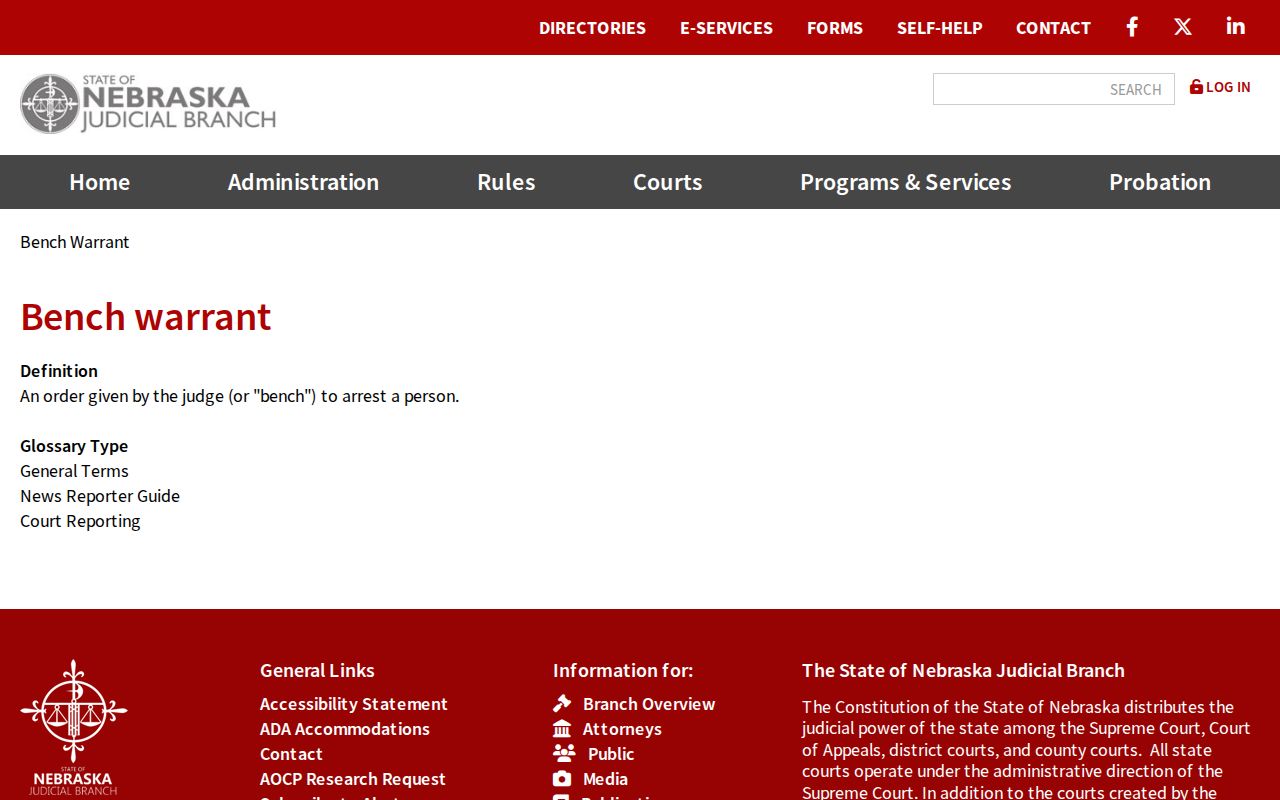
Douglas County's official definition keeps attention on the judge's order and the court that controls it.
Bench Warrants and Arrest Warrants Compared
An arrest warrant usually grows out of a complaint, an affidavit, and probable-cause review. A bench warrant follows a missed court date or order. Either one can end in arrest. But the fix looks different. A Douglas County bench warrant may need a new setting, payment, an ability-to-pay hearing, or an attorney motion, while an arrest warrant more often calls for counsel, a planned surrender, and a bond discussion on the charge.
| Point | Bench warrant | Arrest warrant |
|---|---|---|
| Typical reason | Missed date or noncompliance | Complaint and probable cause |
| Controlling office | Court with the pending case | Issuing court or magistrate |
| Public search clue | FTA, show-cause, or order entry | Complaint, charge, or arrest-order event |
| Next call | Clerk and DCSO confirmation | Clerk, counsel, and DCSO confirmation |
Douglas County Capias Mitimus
DCSO policy uses capias mitimus for one slice of enforcement. The label also goes by commitment-and-time-pay warrant. It often covers unpaid fines, show-cause orders, and similar matters in Douglas County. It is not a synonym for every bench warrant. Under that policy, dispatch can pull the fine or show-cause amount and the warrant number, so ask the issuing court whether payment, an ability-to-pay hearing, or another order is required.
- Capias mitimus
- Commitment or time-pay enforcement term used in the DCSO policy.
- FTA
- Failure to appear at a required setting.
- Show cause
- An order to explain why a court requirement was not met.
- Recall
- The issuing court withdraws the warrant.
Douglas County's own DCSO arrest policy is the source for this terminology. Other Nebraska counties keep their own terms.
Resolving a Douglas County Bench Warrant
Run a JUSTICE search first. Write down the court, case number, missed date, and latest event. Then call the issuing clerk before you go anywhere. Ask whether a Douglas County court will allow a new setting, payment, an attorney motion, a personal appearance, or a fine and cost hearing. Confirm with DCSO or Douglas County 911. Follow the court's instruction for bond, booking, or surrender.
- Locate the case and identify the missed obligation.
- Ask the clerk whether the order is still active.
- Confirm status with DCSO or dispatch.
- Choose the court-directed route, including counsel where appropriate.
- Keep the order, receipt, or release paper and recheck after action.
Do not guess at the counter. The sheriff can confirm operational status, but only the issuing court can recall, quash, or reset the case.
Douglas County Court Contacts
The Hall of Justice houses the shared public location for County Court and District Court functions. County Court Criminal/Traffic sits at 1701 Farnam Street, second floor, reachable at 402-444-5387. Its weekday hours run 8:00 a.m. to 4:30 p.m. District Court lists a clerk phone of 402-444-7018. Separate Juvenile Court is at 1717 Harney Street. Clerk lines are 402-444-7121 and 402-444-7337. Pin down the court first, using the District 4 directory before sharing details. Douglas County juvenile matters especially need the proper clerk, since access is restricted.
When a Douglas County Bench Warrant Means Booking
DCSO policy sends warrant arrests to Douglas County Department of Corrections intake and booking. Nobody walks out until the right bond requirements are met. That does not mean every bench warrant carries the same bond. Paying at a court counter does not close the underlying case either. Get location, timing, identification, and release conditions from the official channel. Foreign warrants work differently. Under the policy, no bond is posted at booking, and County Court takes up bond after arraignment on the fugitive charge. Out-of-state custody follows extradition rules.
Finding the Court That Issued the Warrant
Traffic, misdemeanor, ordinance, and preliminary-hearing matters trace back to County Court Criminal/Traffic. Felony files live in District Court. Separate Juvenile Court handles juvenile cases behind restricted access. Omaha Municipal Court matters take the city court route. Match the court name on the case before any Douglas County call about recall or bond, and use the District 4 directory to sort out the clerk contacts.
Douglas County Fine-Warrant Hearing
Nebraska statute 29-2412 covers people picked up in Douglas County on a warrant for unpaid fines or costs. It also applies after a missed appearance on a fine due date. That person gets a hearing on the first regularly scheduled court date. There the court weighs ability to pay. It can order installments, community service, discharge, or another lawful remedy, so ask the issuing clerk whether the statute fits the record.
Bring proof. Keep receipts, court orders, payment records, and any new setting. A fine payment or bond may not end the pending case.
Read the Nebraska ability-to-pay statute with the court's current instructions.
Verifying a Douglas County Recall
Once the court recalls or quashes a Douglas County bench warrant, ask when the docket will catch up. Call the clerk again with the case number. Then check with DCSO or dispatch that the operational record changed too. A public search can lag behind. Even with the warrant gone, the case may still carry a new hearing, fine, probation term, or other duty. Use the Douglas County warrant search steps when you need to compare JUSTICE with the court and sheriff answers.